How enterprises can turn incident response into a controlled, verifiable process
A critical application slows overnight. Monitoring identifies an unhealthy component, and an engineer finds a familiar remedy: restart a service. The command takes seconds. Determining whether the restart will restore the application or disrupt another dependency takes far longer.
That is the real challenge in enterprise incident remediation. Most IT teams already know how to automate a task. The harder question is when an automated action is justified, who can authorize it, and how to establish that the affected service actually recovered.
How do you automate incident remediation in enterprise IT?
Connect incident detection to service dependencies, diagnostic evidence, approved response workflows, and post-action verification. Automate routine investigation first, then allow execution according to the potential impact of each action. For consequential changes, keep an explicit approval step. The result is not automation without operators; it is less manual work between an alert and a defensible decision.
A successful script can still produce a failed recovery
A script can restart a process without knowing whether it supports a customer-facing transaction, whether another team is deploying an update, or whether a redundant instance is available. An execution log may say “success” while users continue to experience errors.
The design requirement is therefore broader than reliable task execution: connect technical symptoms to service impact, select an action within policy, and evaluate the resulting service health. Existing incident disciplines already distinguish diagnosis from resolution; the next step is to connect those decisions across operational tools rather than relying on an engineer to assemble them manually.
For foundational process guidance, see ScienceLogic’s incident management overview; the focus here is the additional discipline required when software begins taking action.
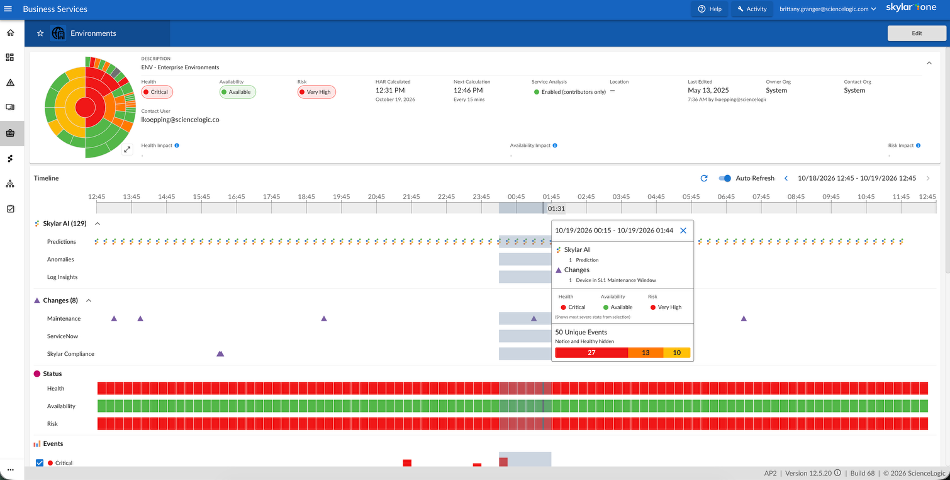
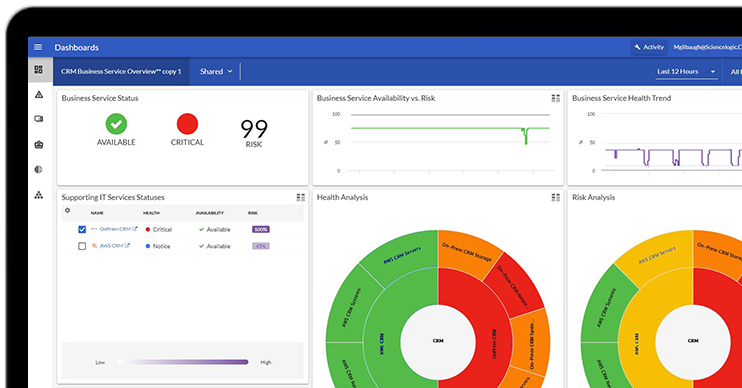
Skylar One provides service-level visibility into health, availability, risk, and underlying dependencies to help teams evaluate the impact of an incident before taking action.
Design for decisions, not just triggers
A production-ready remediation design should answer five questions in order:
- What is affected? Distinguish persistent degradation from duplicate alerts or a planned change, and identify the service at risk.
- What evidence supports the diagnosis? Gather dependency information, current health, relevant changes, and diagnostic details before modifying the environment.
- What action is permitted? Match the incident to a tested procedure, scoped credentials, an approval policy, and a defined failure path.
- What happens if execution fails? Set limits on retries and timeouts, preserve diagnostics, and escalate rather than repeating a potentially harmful action.
- Did the service recover? Validate application behavior or service health, not merely a command’s exit status, and record the outcome.
This approach changes the economic case for automation. Teams can remove repetitive collection and coordination work even when an operator must still authorize a production change. Autonomy becomes a deliberate policy choice rather than a measure of technological ambition.
What controlled remediation looks like during an outage
Consider a customer portal that intermittently returns errors. An approved runbook calls for restarting an application process, but the portal relies on multiple instances and a load balancer. A responsible workflow could:
- Identify the impacted service and confirm whether the fault is isolated to one instance.
- Check recent deployments, maintenance windows, and the health of remaining instances.
- Capture relevant logs and obtain approval if the restart falls outside preauthorized conditions.
- Execute the runbook with bounded retries, then confirm that transactions succeed and errors decline.
- Stop and escalate if the service remains impaired, preserving the diagnostic record.
The operational gain comes from reducing investigation and handoffs while making the recovery test explicit. The example is illustrative; actual checks and approvals depend on application architecture and customer policy.
AI can shorten diagnosis without gaining unlimited authority
AI-assisted investigation can summarize incidents, retrieve relevant knowledge, and propose next steps. Those are meaningful advances when engineers otherwise spend their time moving among dashboards, tickets, and configuration records. But a credible recommendation is not an authorization to change production.
That distinction matters as AI agents gain access to operational tools. Their permissions, accessible data, and available actions need to reflect the same boundaries applied to human-initiated workflows. ScienceLogic’s discussion of governed agent access and live operational data is explored in this Skylar MCP article.
Make operational performance the test
Mean time to resolution is useful, but it cannot reveal whether automation creates recurring outages or silently bypasses controls. IT leaders should examine first-attempt recovery, reopened incidents, exceptions requiring human intervention, and whether a workflow verified service health before closing the incident. Approval wait time also identifies where policy or process design, rather than technology, creates delay.
The principle of verified recovery is not unique to IT operations. For cybersecurity incidents, NIST SP 800-61 Rev. 3 emphasizes secure recovery actions, verification, and documentation. That guidance addresses security response specifically, but it reinforces the importance of measuring what happened after an intervention, not just whether an action ran.
Where ScienceLogic fits
ScienceLogic brings together service-centric observability and workflow orchestration to help IT teams move from investigation to controlled action. Skylar One provides visibility into business service health, availability, risk, and underlying service relationships. Skylar Automation enables teams to create and execute workflows that connect operational data with actions across integrated systems. Through the MCP server integrated into Skylar Automation, compatible AI agents can access supported operational tools and initiate authorized workflows, including eligible runbook automations.
Together, these capabilities provide a foundation for more context-aware incident investigation and remediation. Organizations can build on that foundation with approval policies, execution safeguards, and service recovery checks appropriate to their operational requirements. The goal is not simply to automate more actions. It is to help teams make better-informed decisions, execute approved responses, and verify that services have recovered.
Explore the underlying orchestration capabilities in the Skylar Automation documentation.
The next measure of maturity
The strongest automation programs will not be those that run the most commands. They will be those that can identify which incidents merit automated intervention, explain why an action was selected, and show whether it restored the service. That creates room for greater autonomy where evidence warrants it and deliberate human oversight where the consequences demand it.