Compliance is often treated as a governance responsibility. But many of the conditions that determine whether controls continue to hold are created inside day-to-day IT operations.
Operations teams manage the devices, configurations, changes, dependencies, and remediation activities where compliance can either remain aligned or begin to drift.
Governance defines the requirements. Operations manages much of the environment where those requirements must remain true.
That makes compliance a shared operational discipline.
For CIOs, this shifts the mandate. Periodic audit readiness is no longer enough. Compliance must become part of how mature IT organizations manage change, resilience, and risk every day.
Continuous Control Starts With Operational Awareness
Governance depends on understanding the environment as it operates today.
Continuous control starts with knowing what is running, how it is configured, what has changed, and whether those changes remain aligned with established policies.
That becomes particularly important in large, distributed IT environments that may span hundreds or thousands of devices across multiple vendors.
A configuration change that appears minor in isolation can create a very different level of risk depending on where the device sits, what services depend on it, and what business functions those services support.
That is why visibility alone is not enough. Context matters.
Not every compliance issue has the same operational significance. A policy violation affecting a low-impact system may require a different response from one affecting infrastructure that supports a critical business service.
Connecting compliance information with operational and service context helps teams understand not just what has changed, but where attention is needed first.
Make Evidence Part of Everyday Operations
Continuous control also requires organizations to rethink how they create and maintain compliance evidence.
In a periodic model, teams collect evidence because an audit is approaching.
In a continuous model, evidence is created as operations happen.
Configuration histories, policy validations, changes, remediation activity, exceptions, and ownership records become part of the normal operating record rather than information teams have to reconstruct later.
That fundamentally changes audit readiness.
Teams spend less time trying to determine what happened months earlier because they have a clearer record of what changed and when. Compliance and governance teams gain better information without depending entirely on manual evidence collection. Operations teams spend less time responding to last-minute requests.
Recent Skylar Compliance improvements reinforce this model by making evidence easier to investigate in context. Phrase- and Regex-based compliance violations can surface the relevant file, line number, and line directly in violation details, helping teams move more quickly from a failed rule to the source of the issue. Compliance transcripts can also be enabled on policies, providing a more detailed record for investigating unexpected rule behavior.
Evidence is more useful when it does not simply confirm that a control failed. It helps teams understand where the failure occurred and what happened around it.
The organization becomes more prepared because preparedness is built into normal operations.
Automation Helps Control Keep Pace With Change
Modern IT environments generate too much change for teams to manually compare every configuration, validate every policy, and maintain every evidence record.
Automation can take on much of that repetitive work.
It can help teams:
- monitor configuration changes,
- compare current conditions with established policies,
- identify potential policy violations,
- capture operational records, and
- initiate remediation workflows.
But automation is only as trustworthy as the rules, conditions, and evidence that govern it.
Skylar Compliance is adding more guided rule creation and validation capabilities to help teams define controls with greater precision before they become active. A structured rule-building workflow covers rule information, filters, logic, remediation, test data, and review, giving teams a clearer path to validate expected behavior before enforcement.
New rule filters can also narrow when a rule should run based on device attributes, while rule test data allows teams to document examples that should pass or fail and validate more complex Regex or Lua logic during rule creation.
These are not simply rule-authoring conveniences. They reduce ambiguity before enforcement. Better-defined conditions and testable logic give teams greater confidence that automated compliance checks are evaluating the intended devices, configurations, and policy states.
Automation does not remove human judgment from compliance.
People remain responsible for interpreting policy, assessing risk, evaluating exceptions, and providing oversight. Automation gives them a more current and consistent foundation for making those decisions.
For CIOs, that distinction matters.
The goal is not to automate governance itself. It is to automate the operational awareness, validation, and evidence gathering that allow skilled teams to focus their expertise on decisions that require human judgment.
That principle also shapes planned capabilities such as governed approval workflows for auto-remediation. The objective is not unrestricted automated change. It is controlled execution in which remediation operates within defined approval boundaries and human oversight remains available where risk requires it.
Compliance Is Becoming Part of Operational Excellence
This is where compliance and operational resilience increasingly intersect.
A well-governed configuration environment does more than help an organization prepare for an audit. It can also reduce the risk associated with configuration changes, accelerate recovery, strengthen accountability, and give teams a known state to return to when something goes wrong.
Those are operational outcomes.
A configuration that violates policy may also create a security exposure. A missing backup can increase recovery risk. An undocumented change can make incident investigation more difficult. A device that cannot be restored quickly can extend an outage.
The boundaries between compliance, reliability, security, and resilience are not as clean as organizational structures sometimes suggest.
For CIOs, the more useful question is not whether compliance belongs to operations or governance.
It is whether the operating model can keep control posture aligned with current operating conditions.
Bringing Continuous Control Into Network Operations
For network and security infrastructure, Skylar Compliance operationalizes this continuous-control model in day-to-day operations.
Skylar Compliance centralizes configuration backup and recovery across multi-vendor network environments while providing configuration change monitoring, policy testing and enforcement, compliance reporting, and detailed configuration histories.
Recent and upcoming enhancements are designed to make those controls easier to define, test, investigate, and reuse. Guided rule creation, more precise filtering, test data, richer violation details, and compliance transcripts can reduce the friction involved in maintaining policy logic and tracing unexpected results.
Additional planned capabilities, including reusable rule libraries, pre-built policy content based on standards such as CIS Benchmarks and DISA STIGs, and domain-specific compliance variables, are intended to make control more consistent across larger and more complex environments.
That matters because control logic becomes difficult to govern when similar rules are recreated and maintained separately across policies and domains. Reusable rules and standardized policy content can reduce duplication while still allowing teams to account for local operating requirements.
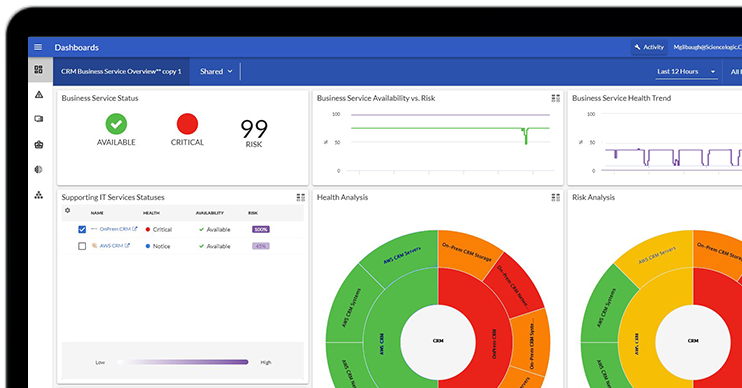
Skylar Compliance can also integrate with Skylar One, helping organizations connect configuration and compliance information with broader operational intelligence and business service context.
The goal is not to replace every governance, risk, and compliance process across the enterprise.
It is something more practical: providing stronger continuous control over network configurations that directly affect security, service availability, and operational resilience.
From Audit Readiness to Continuous Control
The future of compliance will not be defined by better last-minute audit preparation.
It will be defined by how effectively organizations maintain a known, governed state while their technology environments continue to change.
Continuous control does not eliminate risk. It enables leaders to identify drift earlier, understand its operational significance, and respond before a configuration issue becomes a larger compliance, security, or availability problem.
That also makes compliance more sustainable. Teams do not have to continually rebuild evidence after the fact because the operational record develops alongside the environment itself.
For CIOs, this is the larger shift: compliance is becoming part of the modern IT operating baseline.
Organizations that connect control with everyday operations can improve audit readiness while strengthening resilience, accountability, and confidence in how technology risk is managed.
See Where Compliance May Already Be Drifting
Learn how Skylar Compliance helps network teams detect configuration drift, identify policy violations, maintain audit-ready change histories, and recover quickly when change introduces risk.
How confident are you that the configuration state documented during your last review still reflects what is running today?