Organizations across industries are accelerating their investments in AI for operations, yet the path to meaningful impact is proving far more complex than early expectations suggested. Analysts at Gartner, Forrester, Deloitte, and McKinsey continue to highlight the same structural barrier. AI cannot produce accurate predictions or safe automation when the operational data feeding it is fragmented, incomplete, or inconsistent. Before enterprises can mature their AI programs, they must modernize how they collect, govern, and interpret signals across their digital environments. This reality has placed observability at the center of AI readiness.
Leaders want AI systems that reduce toil, prevent service incidents, orchestrate workflows intelligently, and deliver guidance that improves performance. They want AI to augment their teams and elevate their operational capabilities. Yet AI can only be as reliable as the inputs it receives. When enterprises provide noisy telemetry or context that varies across tools and domains, AI models struggle to learn the patterns required for accurate judgment. The desire for smarter, more autonomous operations is widespread, but the conditions required to support them are not yet standard.
AI adoption is colliding with visibility gaps that cannot be ignored
Many organizations are discovering that they lack the cohesive operational picture AI requires. Their environments span multiple clouds, hybrid architectures, containerized workloads, edge services, SaaS platforms, and legacy systems that behave differently under stress. Each domain produces telemetry with distinct fidelity, structure, and meaning. Tools interpret service health differently. Teams fill knowledge gaps with tribal understanding rather than shared context. Critical discrepancies often exist between what the environment is doing and what the monitoring stack reveals.
These gaps create a structural obstacle for AI. Models trained on partial or contradictory signals generate unreliable results. Automated actions built on incomplete visibility can escalate instability instead of reducing it. Leaders are recognizing that AI progress does not come from adding more algorithms or stitching together more platforms. It comes from improving the quality, completeness, and coherence of the operational data AI relies upon.
AI adoption curves and observability maturity are now inseparable. Organizations advance their AI initiatives only as quickly as their visibility strategy allows.
AI cannot improve operations when the enterprise is feeding it the wrong inputs
AI performs best when it receives clean signals, stable context, and a complete representation of the environment. It learns from clarity. It falters in complexity that lacks structure. Most organizations operate with data that tells conflicting or incomplete stories. Telemetry streams vary across tools. Dashboards reflect narrow slices of the environment. Metadata is missing or outdated. Dependencies are undocumented or buried in legacy systems. These issues erode the model’s ability to understand true service behavior.
This dynamic shows up in daily operations. A degraded node appears benign because contextual metadata is missing. A dependency buried inside a legacy tier becomes invisible to the model, which reduces the accuracy of downstream predictions. Excess noise dilutes the signal. Incomplete relationships hinder correlation. Conflicting interpretations of service health confuse the system that is meant to guide teams.
AI does not fail because it lacks potential. It fails because the information feeding it is insufficient to produce reliable outcomes. This is why leadership attention is shifting toward operational truth rather than AI features.
Observability is evolving into the prerequisite layer for AI-driven operations
As organizations move toward autonomous operations, observability has shifted from a diagnostic function into a strategic requirement. Leaders increasingly understand that they cannot deploy predictive intelligence or automated remediation on top of fragmented or inconsistent visibility. They need a single, coherent understanding of the environment before AI can predict, prevent, or correct anything.
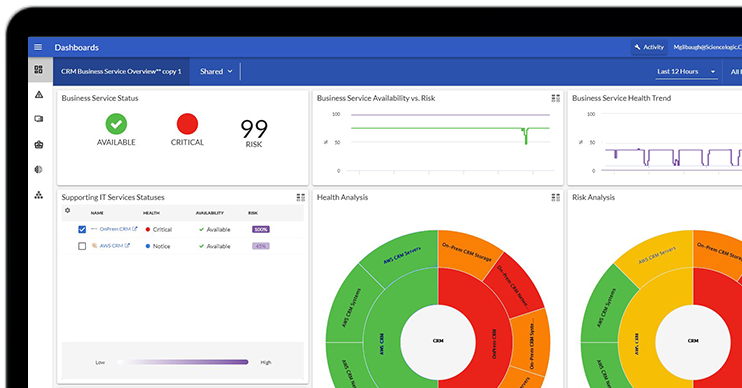
Modern observability provides this foundation by delivering high-fidelity signals, unified context, and aligned views of service health across distributed ecosystems. It brings together metrics, logs, traces, and events into a consistent representation of system behavior. It maps dependencies so the model can evaluate the real impact of changes or anomalies. It connects technical signals to customer-facing services so AI can prioritize what matters to the business rather than what is most visible to infrastructure.
With these conditions in place, AI becomes a strategic advantage instead of a risk factor.
Explainability and trusted data are rising to the executive agenda
Executives who once focused primarily on cost and performance now focus on AI safety, validation, and decision quality. They want to understand how AI reaches conclusions. They want assurance that automated actions are grounded in real, complete information. They want confidence that AI will not intensify incidents, misinterpret telemetry, or destabilize systems that are already complex and interdependent.
Explainability depends on trusted data. Models built on inconsistent or incomplete inputs cannot produce outcomes that humans can confidently evaluate. Observability has therefore entered leadership conversations as the mechanism that ensures AI remains grounded in truth. Service centricity plays a pivotal role by aligning operational behavior with the business context executives care about. When AI operates on signals that accurately reflect service health and real dependency structures, leaders can trust the guidance it provides.
AI maturity has expanded beyond capability into a broader conversation about governance and reliability. Observability supports both objectives.
High-integrity signals unlock predictive and autonomous operations
Organizations frequently ask why their AI initiatives have not delivered the anticipated value. In many cases the answer is straightforward. AI is struggling with poor inputs. Models cannot learn accurate patterns from inconsistent telemetry. Predictions lose meaning when the environment shifts in ways the model cannot see. Automated actions become unsafe when underlying visibility lacks completeness.
Observability resolves these issues by improving the quality and alignment of the signals AI consumes. High-integrity data allows models to identify patterns with greater precision. Consistent context enables clearer differentiation between noise and meaningful anomalies. Rich dependency mapping strengthens predictions by revealing upstream and downstream impact. Service-aware views allow AI to prioritize actions through a business lens rather than a purely technical one.
When AI receives the right inputs, it guides teams with confidence, detectis early indicators of failure, and executes autonomous actions that reduce operational burden.
Observability is the fuel that determines whether the AI engine moves forward or stalls
Enterprises are eager to harness AI to create more resilient, efficient, and predictive operations, yet many attempt to achieve this with telemetry that was never intended for learning systems. AI cannot thrive in environments defined by signal noise, context gaps, and conflicting interpretations of system health. It needs clarity, consistency, and coherence. Observability provides these conditions by offering a unified, factual understanding of the environment.
Organizations that succeed with AI will be the ones that treat observability as a foundational investment rather than a supplemental capability. They will build AI programs on operational truth, not operational assumptions, advancing with confidence grounded in data aligned to real service behavior.
If AI is on your roadmap, observability is not optional. It is the prerequisite.