This year’s Gartner IT Infrastructure, Operations and Cloud Strategies Conference made one thing abundantly clear: the industry is moving beyond reactive monitoring and isolated dashboards toward autonomous, outcome-driven IT operations. While AI and agentic automation dominated keynotes and vendor messaging, conversations on the show floor reflected a more grounded reality. IT leaders are grappling with practical challenges: alert fatigue, tool sprawl, limited operational context, and the ongoing struggle to translate observability investments into measurable business value.
At ScienceLogic, the conference validated both what we hear from customers every day and the direction we continue to invest in. Between packed demo sessions, meaningful conversations with I&O leaders, and recognition in the Gartner Magic Quadrant for Observability Platforms, the week reinforced that the market is aligned on the destination, even if the journey looks different for every organization.
Across keynotes and sessions, Gartner reinforced a consistent narrative about the evolution of IT operations.
Autonomous operations are coming, but maturity varies widely
Gartner highlighted that by the end of the decade, the majority of digital operations will be supported by autonomous capabilities. However, most organizations remain early in that journey, and unfortunately most have seen little to no ROI. The playbook is rather straight forward, moving from human-initiated actions to automated workflows, then to knowledge-driven decisions, and ultimately to autonomous execution.
A recurring message was that technology alone isn’t enough. Success depends just as much on people, process, governance, and trust as it does on AI models or automation frameworks. This sentiment resonated strongly in our show-floor conversations, where many leaders expressed enthusiasm about AI’s potential, but worried about trusting it’s results and ultimately if successful deploying it responsibly at scale.
Alert fatigue and tool sprawl remain top pain points
Despite years of investment in monitoring and observability tools, alert noise and fragmented tooling continue to plague I&O teams. Gartner analysts repeatedly cited environments overwhelmed by alerts that lack context or prioritization, particularly where legacy and modern tools coexist.
IT leaders spoke candidly about misaligned spend, low tool adoption, and dashboards that look impressive but fail to drive faster or better decisions. Fewer alerts, stronger correlation, and actionable insights matter far more than raw data volume.
Observability must connect to business outcomes
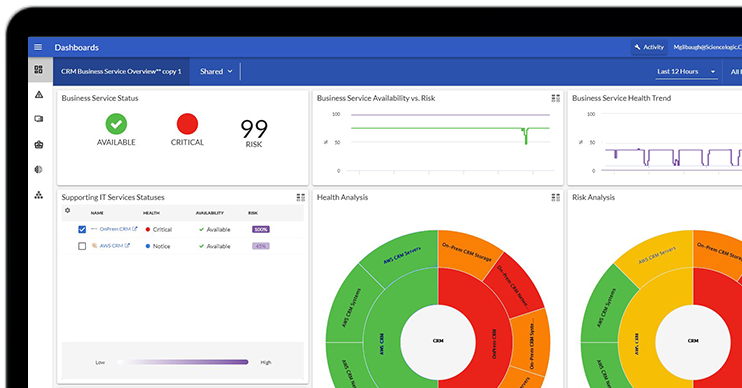
One of the strongest themes across Gartner sessions was the need to elevate observability beyond infrastructure metrics and toward business relevance. Gartner emphasized aligning observability to services, customer journeys, and KPIs or risk eroding confidence and adoption across the organization.
Cost optimization, resilience, and customer experience were consistently cited as outcomes observability platforms must support. This reinforced growing expectations that observability investments must clearly demonstrate how they improve efficiency, reduce risk, and support revenue-impacting services.
What We Heard on the Show Floor
Beyond formal sessions, the most valuable insights came from conversations with IT leaders at our booth, where they openly discussed their challenges and IT journeys.
Governance and explainability are no longer optional
There was strong interest in explainable and responsible AI, particularly for incident response and remediation. Many leaders expressed concern about black-box decision-making and emphasized the need to understand how AI arrives at conclusions before trusting it to take action.
This focus on explainability closely aligns with Gartner’s emphasis on trust as a prerequisite for autonomous operations and validates why transparency and auditability are becoming table stakes.
Agent sprawl is emerging as the next challenge
As agentic AI gains traction, a new concern is taking shape: unmanaged agents creating the same chaos tool sprawl caused over the last decade. Conversations frequently highlighted the need for agent governance, control planes, and consolidation strategies to prevent fragmentation.
Rather than deploying dozens of disconnected agents, IT leaders are looking for cohesive platforms that orchestrate intelligence across domains.
Self-service observability with guardrails
Many attendees expressed interest in self-service observability, particularly for application and platform teams, while stressing the importance of guardrails. Observability Centers of Excellence were frequently cited as a way to balance speed and flexibility with standards, governance, and cost control.
A cloud reality check
While cloud remains critical, discussions were noticeably more pragmatic than in previous years. Gartner sessions and show floor conversations acknowledged selective cloud repatriation driven by cost, latency, security, and legacy application constraints. Hybrid operations, data at the edge, and resilience across environments were front and center.
Vendor Messaging and Market Signals
Across the show floor, vendor messaging revealed where the market is converging.
Many platforms emphasized knowledge graphs, unified telemetry, and AI-driven automation as foundations for autonomous workflows. Others focused on rationalizing tool sprawl, improving data control, and filtering noise before it becomes an operational burden.
A consistent pattern emerged: buyers are less interested in flashy AI claims and more focused on maturity, governance, and outcomes. Advisor-style capabilities that deliver prediction, recommendation, and guided remediation are increasingly expected, not experimental.
This aligns with Gartner’s view that the future of observability lies not in collecting more data, but in delivering trusted insights teams can act on with confidence.
Throughout the conference, we had strong engagement from IT leaders eager to simplify operations, reduce noise, and build a path toward more autonomous environments. Demos sparked conversations around context-aware observability, automation, tool consolidation, and tying technical insights directly to service and business impact.
Being recognized in the Gartner Magic Quadrant for Observability Platforms added meaningful validation to those discussions. It reinforced that ScienceLogic is aligned with where the market is headed and focused on solving the problems that matter most to I&O teams today.
The Bottom Line
Gartner IOCS 2025 underscored that the destination is clear: autonomous, intelligent operations powered by AI and agentic automation. But the path forward is defined by trust, governance, and real-world value.
Organizations that reduce alert noise, simplify fragmented environments, and connect observability to business outcomes will be best positioned to succeed. The conversations at Gartner made it clear that IT leaders are ready for this next phase provided it delivers clarity instead of complexity.
For ScienceLogic, the conference reaffirmed our focus and strengthened our conviction that outcome-driven observability is the foundation for the future of IT operations.