The “What If” Series
Enterprises are experiencing a turning point. Systems scale faster than teams can, AI is rewriting the rhythms of operations, and the cost of downtime grows heavier every quarter. In this new landscape, reacting is no longer enough. Teams need foresight. They need to get ahead of the issue. They need a different model entirely.
This third installment centers on a simple but transformative idea. What if IT operations could finally step out of reaction mode and move into anticipation?
To explore that shift, we turn to Arturo Oliver, Sr. Director of Market Strategy and Analyst Relations at ScienceLogic. He spends his days listening to the hidden patterns that define how IT environments behave, and how AI will reshape the way teams manage stability and resilience.
The Question
What if IT stopped reacting to incidents and started predicting them?
Arturo frames the entire conversation with clarity. “Reactive versus predictive. That is the question right.”
It is more than a mindset shift. It is a structural change in how enterprises think about risk, resilience, and operational accountability.
For years, IT has been defined by its response times. How quickly teams react. How fast they resolve outages. How efficiently they patch, troubleshoot, or remediate. But once an incident occurs, speed offers only a limited form of value. It focuses on aftermath, not avoidance. Because the moment an outage happens, the damage—lost revenue, broken SLAs, and eroded trust—can be immediate and sometimes irreversible.
True progress begins earlier, in the moments before conditions break.
The Costs of Living in Reactive Mode
Arturo offers a metaphor that lands with precision. He asks us to imagine meteorologists who only appear on screen after destruction has already happened. “If the meteorologists would jump into the TV and just announce, you know, we happened to have a hurricane, and it destroyed all these houses… would they be popular? No, they would be hated. That is how IT teams feel today.”
Being the bearer of bad news is not the same as preventing it. Yet that is the position many operations teams find themselves in. They are held accountable for conditions they could not possibly have anticipated, because their tools lack the visibility and pattern recognition needed to warn them in advance.
The result is predictable. Burnout. Blame. Endless cycles of crisis management. Limited time for innovation. And a culture of reactive heroism that keeps organizations trapped in the past.
The Predictive Moment
Prediction is not magic. It is mathematics. Patterns. Probabilities. The steady fingerprints of cause and effect embedded in telemetry.
“With AI and all the data that it uses, it can uncover patterns. There are patterns in the data that you can start to unravel and analyze and provide those early warnings so you can avoid an issue altogether.”
Early warnings are the turning point. They give teams the advantage they have never had: time. Space to act. A chance to intervene before customers feel pain or systems decline.
To illustrate this shift, Arturo draws from his own life. “I grew up in Mexico City. I went through earthquakes. The devastation… Nowadays the country has an early warning system. It gives something like around 30 to 45 seconds. But those are crucial seconds that give you time to act, make smarter decisions, and reduce the impact.”
Thirty seconds is not a luxury. It is an operational advantage. A window where preparation and action become possible.
For IT, predictive insight creates that same window. Not everything can be prevented, but far more can be anticipated than most enterprises realize.
From Aftermath to Foresight
The shift from reactive to predictive operations changes more than workflows. It changes identity.
“When teams become more predictive on the issues and less reactive, they are less blamed… They become strategic partners, crucial organizations that keep us out of trouble as a company. That is where the real innovation starts taking place.”
Prediction elevates IT. It gives teams the freedom to focus on improvement instead of cleanup. It replaces adrenaline with insight. It lets operations become the advisor instead of the responder.
Enterprises that operate with foresight do not wait to be surprised. They chart the conditions that lead to failure and design their systems to move ahead of them.
How ScienceLogic Enables Predictive Operations
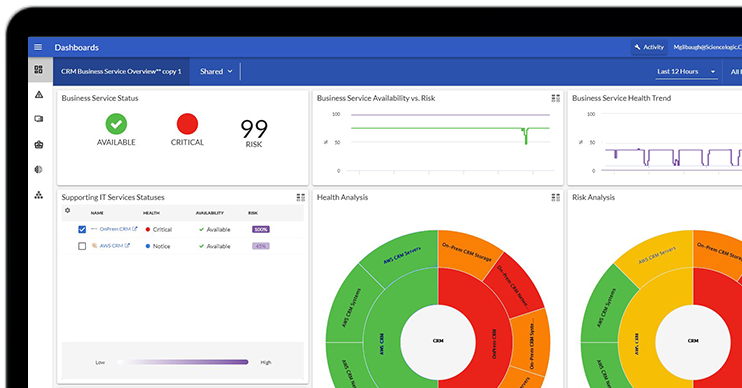
The ScienceLogic AI Platform gives teams the visibility and intelligence needed to predict with confidence. Its design connects the signals that matter and reveals the patterns hidden within them.
Skylar AI correlates telemetry and uncovers the early indicators that precede incidents.
Skylar Automation acts on those insights with precision so teams can intervene faster.
Skylar Compliance centralizes configuration changes so state drift and misconfigurations can be detected before they trigger an outage.
Together, they create an environment where IT does not wait for problems to surface. It sees them forming.
Prediction is not theoretical. It is operational. It is measurable. And now, it is possible.
The Takeaway
The future of IT belongs to teams that refuse to be defined by emergencies. Prediction is the maturity milestone that changes everything. It reduces toil, increases stability, and turns data into foresight.
IT leaders who embrace predictive visibility will not just protect the business. They will guide it.
Because resilience is not about reacting. It is about anticipating.
Next in the Series
What if observability became the way enterprises governed AI itself?