As intelligence becomes increasingly accessible, competitive advantage shifts to the operational capabilities that transform insight into consistent, confident action.
As AI makes operational insight easier to generate, competitive advantage is shifting to the platforms, workflows, and operational foundations that turn intelligence into trusted action.
For most of enterprise IT’s history, operational advantage was tied to capabilities that were difficult to build. Monitoring, observability, and advanced analytics created value because they helped organizations understand complex environments, and differentiation because few could implement them well. Teams that correlated events and explained failures more accurately often responded faster and operated with greater confidence. Intelligence itself was part of the advantage.
That model is changing. AI is making sophisticated analysis more accessible. Capabilities that recently differentiated leading operations platforms, including anomaly detection, event correlation, root cause analysis, and remediation recommendations, are becoming more common. More vendors now demonstrate similar AI-driven insights and promises of faster resolution. Intelligence is not less valuable. It is less scarce.
As AI-generated insight becomes more widely available, the differentiator shifts. The question is no longer only, “Can the system produce a recommendation?” Increasingly, the more important question is, “Can the organization trust that recommendation, understand the operational context behind it, coordinate action around it, and learn from the outcome?” That is where competitive advantage is moving.
Intelligence Alone Does Not Create Operational Outcomes
Enterprise IT does not struggle because it lacks information. Most organizations already operate with more data than their teams can reasonably interpret: telemetry, events, logs, topology, service relationships, tickets, change records, documentation, runbooks, and business priorities. AI can help make sense of that complexity faster, but insight alone does not resolve incidents, reduce risk, or improve service performance.
A technically correct recommendation still has to move through enterprise operations. Teams must understand service impact, validate dependencies, determine whether an action violates policy or creates customer-facing risk, and decide whether the organization is ready to act. This is where decision latency is introduced. Better analysis does not automatically produce better outcomes.
The recommendation is only the beginning. The value comes from what happens next.
That distinction matters more as AI moves from passive assistance toward agentic workflows and autonomous action. When AI recommends, fragmented context slows decisions. When AI acts, fragmented context compounds risk. Incomplete service dependencies, outdated documentation, unclear ownership, or inconsistent governance can turn speed into a liability. The future of enterprise AI will be defined not by intelligence alone, but by the operational foundation required to apply it safely and at scale.
What AI Still Depends On
As AI capabilities become more accessible, the durable advantage lies in the conditions that determine whether those capabilities can be applied effectively. In enterprise operations, those conditions are difficult to replicate.
Three operating requirements become especially important as AI moves closer to action:
- Context: Ground truth about what is actually deployed, how services relate, and which dependencies connect technology to business outcomes.
- Control: Observability into agent behavior and decisions, paired with auditability and enforceable policy boundaries that constrain agent action.
- Cost Management: Visibility into utilization and spend, connected to operational outcomes so leaders can evaluate cost, value, and ROI.
Together, these requirements provide the understanding, guardrails, and economic discipline required for trusted action.
These requirements depend on a continuously accurate understanding of how the enterprise operates, including topology, service relationships, business context, change activity, governance requirements, and dependencies. They also require an operating model that moves teams from insight to coordinated action without repeatedly debating ownership, risk, or current state. AI can accelerate analysis, but it cannot create these foundations.
Two organizations can deploy similar AI and receive very different results because their architectures, service dependencies, operational histories, risk tolerances, policies, and priorities differ. The capability may be similar, but the operational reality it must reason across is unique. As models become easier to access, what remains difficult to duplicate is the enterprise-specific understanding built through years of operating and changing the environment.
The New Source of Operational Advantage
This shift changes how enterprise leaders should evaluate. Models, assistants, agents, and automation features matter, but they are becoming the starting point, not the finish line. Operational readiness will determine whether they produce better outcomes.
The strategic question is whether the organization has a platform that connects intelligence to the live operating environment. That means grounding AI in observability data, topology, service relationships, incident history, documentation, governance policies, and business context, while giving teams a shared operational view so they can act without rebuilding context as work moves across people and systems.
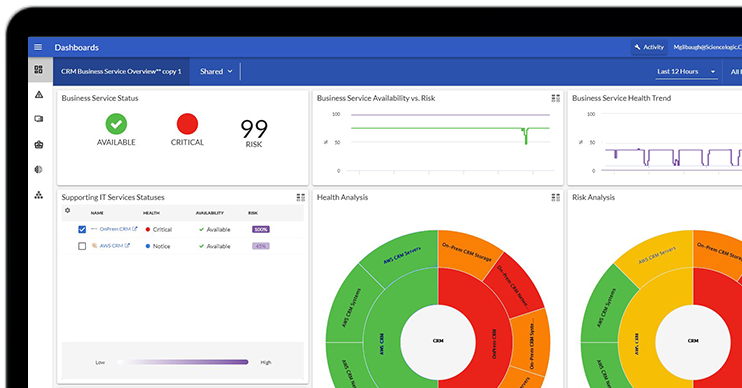
This is where ScienceLogic has a clear point of view. The ScienceLogic AI Platform is designed to help enterprises move beyond insight alone by connecting service-centric observability, AI-driven operations, and policy-governed automation. The goal is not simply to generate more recommendations. It is to help organizations establish the operational foundation needed to understand what is happening, determine what should happen next, and act with confidence across complex hybrid environments.
Skylar AI provides the intelligence layer of the ScienceLogic AI Platform, helping teams reason across operational context and surface guidance that can be understood and validated. Grounded in live operational reality, that intelligence can inform the workflows where decisions and action happen.
From Insight to Trusted Action
The industry has spent years improving the ability to detect, analyze, and recommend. AI will continue to accelerate that progress. But the next phase of enterprise operations will be defined by something more difficult: building the operational foundation that allows intelligence to produce better decisions and trusted action.
That foundation includes a shared understanding of the environment, confidence in the data behind recommendations, clear ownership, governance that can operate at the speed of AI, and learning loops that improve future decisions based on real outcomes. Without that foundation, better intelligence can expose the same operational weaknesses faster. Recommendations still stall. Teams still rebuild context. Knowledge still disappears after incidents. Automation still creates risk when it acts without sufficient context, policy boundaries, or verification.
With that foundation, AI becomes more than a faster way to analyze data. It becomes part of a larger operational system that helps teams observe, advise, verify, and automate with greater confidence. As intelligence becomes more available, advantage will belong to organizations that can operationalize it, not just by deploying AI features, but by creating the conditions that allow AI to be trusted, coordinated, and continuously improved inside the workflows where operations happen.
This is the first in a series exploring that shift. The first question is what happens after AI produces a recommendation. Because in enterprise operations, insight does not create value until teams can act on it with confidence.
Continue the Conversation
Learn how the ScienceLogic AI Platform helps enterprises build the operational foundation for AI-driven operations, connecting observability, guidance, automation, and trusted action across complex hybrid environments.