Why Modern Operations Struggle for Clarity and What Happens When They Finally Achieve It
Most people assume the modern enterprise runs cleanly on the dashboards and cloud consoles that dominate today’s digital workspaces. Anyone who operates these environments understands a more complicated truth. The real work happens beneath those surfaces, in systems few people notice until something slips. Across industries, engineers face the same recurring scenario: a routine shift disrupted by signals of degradation somewhere in the environment. A service slows in one region, an application becomes unstable in another, and a critical workflow issues an alert whose urgency is unclear. Screens brighten, notifications escalate, and for a period of time, no one can definitively explain what is unfolding. This is the everyday reality of operations: essential, complex, and often obscured by partial information.
One of the most persistent obstacles is not a malicious adversary. It is fragmentation. Organizations accumulate tools built for isolated purposes: logs in one platform, cloud activity in another, visibility solutions inherited from past acquisitions, and new dashboards added during modernization. Each decision is rational on its own, but together they create disconnected insights. Teams debate responsibility, data conflicts across systems, and root cause becomes something discovered through persistence rather than understanding. Fragmentation erodes the ability to see what the environment is actually doing.
Every clue exists; it’s just scattered.
When the World Gets Loud
Many practitioners recall the moment fragmentation became undeniable. A routine alert escalated into a multi-team incident. Chat threads filled with conflicting theories and interpretations of partial data. The familiar early question, “Is this our issue or someone else’s?” surfaced before anyone could know. The underlying technical issue may not have been complex, but the insights needed to diagnose it were dispersed across systems that do not interoperate. All the necessary clues existed, but they were spread across dashboards, logs, tickets, and institutional memory. The challenge was not the technology. It was the inability to view the environment as a coherent whole.
Operations as Relationships
Over time, engineers realize their environments do not behave according to architectural diagrams. They run on relationships. Services influence one another in nonlinear ways. Dependencies accumulate across years of configuration changes and migrations. Infrastructure decisions in one layer create consequences in another. The relationships between people—who knows what, who owns what, who remembers prior incidents—carry equal weight. Yet most tools present the environment as isolated objects. Understanding an environment through fragmented views is like trying to interpret an orchestra through a single instrument or trying to understand a storm through one window.
When teams recognize that their environment behaves as a system rather than a collection of components, a different question naturally follows.
Eventually someone inside the organization asks a deceptively simple question: what if we could understand the environment as it actually behaves, rather than as individual tools describe it? The question resonates because it names a long-standing constraint. If relationships between systems were visible and behavior understood contextually, incidents would no longer unfold as mysteries. Teams could begin from shared understanding instead of speculation.
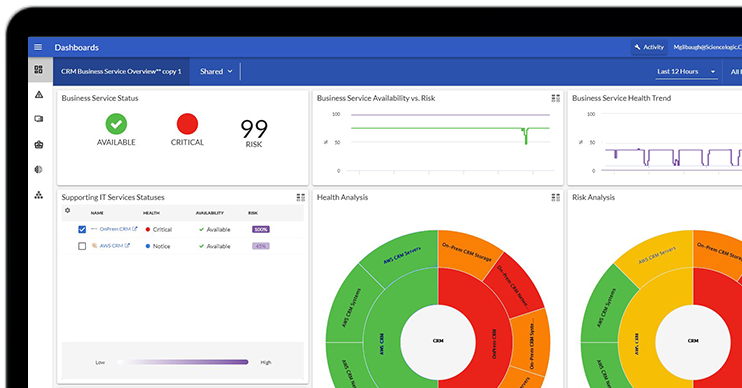
This is where a new capability enters the narrative: clarity. Clarity connects signals to causes. It moves organizations from reactive interpretation to real understanding. In environments overwhelmed by data, clarity enables faster identification of issues, stronger coordination across teams, and a more confident operational posture. Instead of navigating ambiguity, teams gain a coherent view of what their environment is doing and why.
Clarity is the first capability that changes outcomes.
When Understanding Becomes Guidance
Once clarity exists, a second capability becomes possible: guidance. This is not brittle automation that fails when dependencies shift, nor AI that generates confident but uninformed recommendations. Guidance is reasoning built on truth. When an environment is understood contextually, recommended actions become reliable. Teams respond more effectively because they understand the dynamics of the environment, not isolated symptoms. Engineers often describe this shift as the first time their systems felt intelligible instead of opaque.
Why This Story Matters Now
Organizations everywhere face the same paradox: they have more tools, telemetry, and dashboards than ever, yet they struggle to answer the foundational operational question—what is actually happening? The issue is not complexity or a lack of expertise. Most organizations have not treated clarity as a prerequisite for operational resilience. Without clarity, teams spend valuable time reconciling data sources instead of resolving the incident. ScienceLogic enters this landscape to make environments understandable as they truly operate. When teams gain clarity, they gain the foundation for trustworthy guidance and confident action.
The value is not in adding another tool. It is in making the environment legible. When teams can finally see the world beneath their dashboards, they move from fragmentation to comprehension. They gain the ability to act with a level of understanding that has long been out of reach, and that is the first step toward a more resilient, more predictable, and more intelligent operational future.