Last updated: 9/24/26
IT operations, or ITOps, focuses on keeping production services reliable, available, secure, and cost-efficient. DevOps improves how teams build, release, and operate software through shared ownership, automation, and fast feedback.
The ITOps vs. DevOps comparison is not about choosing one model over the other. The strongest operating models connect the two through common service context, observability, service-level objectives, governed automation, and learning after incidents.
The practical test is straightforward: Does every production service have clear ownership, and can teams work from the same evidence when something fails?
ITOps vs. DevOps at a Glance
| Dimension |
ITOps |
DevOps |
| Primary purpose |
Operate and protect production services and shared technology. |
Improve the flow of software changes from idea to reliable operation. |
| Typical scope |
Infrastructure, networks, cloud operations, service health, incidents, capacity, continuity, and cost. |
Source control, testing, continuous delivery, infrastructure as code, deployment, and runtime feedback. |
| Change approach |
Balances stability, risk, maintenance, and service commitments. |
Seeks small, repeatable, automated changes with rapid feedback. |
| Core metrics |
Availability, SLO attainment, incident impact, restoration time, capacity, cost, and toil. |
Deployment frequency, lead time, recovery time, change fail rate, and product outcomes. |
Shared objective: Deliver valuable change at a sustainable pace while keeping customer-facing services within agreed reliability, security, and cost boundaries.
What Is ITOps?
ITOps comprises the people, processes, and technology used to run a production IT environment. Effective ITOps is service-centric: operators need to know which service depends on a resource, who owns it, what users are experiencing, and which response is safe.
That requires current discovery, topology, observability, and integration with IT service management, configuration, collaboration, and automation platforms.
What Is DevOps?
DevOps brings software development and operational concerns into a shared delivery system. It emphasizes cross-functional ownership, automated testing and deployment, infrastructure as code, small changes, rapid feedback, and learning from production.
DevOps does not prescribe a single role or organization chart. The consistent principle is that teams that change a service participate in making that service operable and reliable.
Where ITOps and DevOps Overlap
Both disciplines care about production outcomes. They meet wherever a change affects a live service: release of readiness, observability, configuration, capacity, incident response, security, cost, and customer experience.
A delivery pipeline that ends at deployment is incomplete. Production evidence must flow back into engineering decisions.
Shared operating loop: Code or change → Build and test → Deploy → Observe → Respond → Learn and improve
For that loop to work, teams need four things:
Clear service ownership. Identify technical and service owners, support paths, reliability objectives, dependencies, and escalation of contacts before an outage begins.
Common telemetry and context. Connect deployment markers, traces, logs, metrics, events, configuration changes, topology, and incident history through consistent service identities and timestamps.
Reliability guardrails. SLOs define the target reliability a service should provide, while error budgets give product and operations teams a shared basis for balancing innovation and reliability.
Governed automation and learning. Enrich incidents with service impact, recent changes, owners, diagnostics, and runbooks. Production actions such as rollbacks or restarts should use least privilege, validation, rollback provisions, approval logic where required, and audit trails. Blameless reviews should improve code, tests, release safeguards, monitoring, runbooks, and ownership.
The issue is not whether ITOps or DevOps owns production. It is whether the operating model gives both teams enough shared context to protect reliability while change continues.
Scenario: A Release Causes Checkout Failure
A product team deploys a new checkout version. Within minutes, payment latency rises and customers abandon orders. Product or DevOps engineering assesses the release and rollback options. ITOps evaluates service impact, dependencies, infrastructure, and network health. Platform or SRE teams examine reliability controls, while service desk and business owners coordinate priority and communication.
The teams should not need to debate who “owns production” during the outage. The service model, escalation path, and release context should make initial responsibilities clear.
After restoration, the teams jointly determine why the controls failed and how the delivery and operating systems should change. The goal is not only to recover faster next time. It is to reduce the likelihood that the same failure reaches customers again.
Metrics That Reinforce Collaboration
Metrics create conflict when each team optimizes its own number. Delivery speed without reliability creates rework. Stability without a safe path for change creates stagnation.
Balance deployment frequency and lead time with change fail rate, SLO attainment, restoration time, toil, customer impact, and cost. Apply metrics at the service level rather than as a cross-team scoreboard.
High-performing teams are not optimizing delivery and operations separately. They are managing the end-to-end health of the service.
Seven Ways to Make ITOps and DevOps Work Better Together
Where does the operating loop break in your organization: ownership, context, handoffs, or action?
- Organize around services, not tool boundaries. Maintain a current service model that connects owners, dependencies, environments, support paths, and business importance.
- Make deployment and change context observable. Place release, feature-flag, infrastructure-as-code, and configuration markers alongside operational telemetry.
- Define SLOs with product and business input. Set reliability targets according to user expectations and the cost of failure.
- Standardize incident handoffs. Enrich incidents automatically with service impact, recent changes, diagnostics, and the correct responder group.
- Create safe paths for common actions. Turn proven runbooks into governed workflows with the least privilege, approval, validation, rollback, and auditability.
- Review failures without blame. Use incidents and failed changes to improve architecture, tests, release controls, observability, and documentation.
- Measure the end-to-end outcome. Track whether delivery and operations together improve reliability, recovery, customer experience, and cost.
Across these practices, a consistent pattern emerges: collaboration improves when teams share service context, operational evidence, and governed paths to action rather than relying on separate tools and handoffs.
How ScienceLogic Connects Delivery and Operations
ScienceLogic value areas relevant to ITOps and DevOps include Service-Centric Observability, AI-Driven Operations, Intelligent Automation, Operational Efficiency, and Service Reliability.
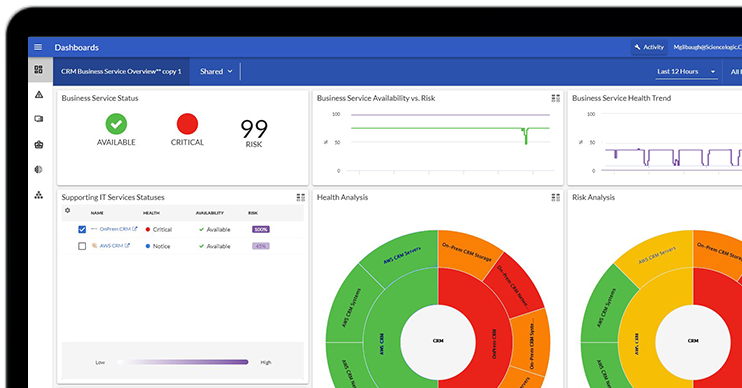
Skylar One brings observability, service context, and action together across complex hybrid and multi-vendor environments. It unifies operational evidence such as metrics, logs, events, configurations, topology, and relationship data so teams can understand dependencies and service impact.
Skylar Automation connects Skylar One data, signals, and insights with IT service management, DevOps, cloud, and collaboration tools. Its low-code and no-code capabilities support reusable integration and automation workflows across the IT ecosystem.
Skylar Advisor turns telemetry, tickets, documentation, and operational knowledge into prioritized, explainable guidance, with supporting context and evidence teams can verify before acting.
These capabilities do not replace DevOps ownership, ITOps expertise, or SRE practices. They reduce friction by making service relationships, operational evidence, and governed actions easier to share across the teams responsible for production outcomes.
Frequently Asked Questions
Is ITOps the Same as DevOps?
No. ITOps focuses on operating and protecting production services and shared technology. DevOps improves software delivery and operation through shared ownership, automation, and feedback. They overlap wherever software changes affect production.
Does DevOps Replace IT Operations?
No. DevOps changes how responsibilities are shared, but organizations still need infrastructure, service management, incident response, capacity, continuity, security, and vendor-management capabilities.
What Is the Best Way to Connect ITOps and DevOps?
Start with a shared service model, compatible telemetry, clear ownership, observable deployment context, SLOs, standardized incident handoffs, governed automation, and a feedback loop that turns operational learning into delivery improvements.
Scale ITOps Without Scaling Complexity
Connecting ITOps and DevOps is not simply a collaboration exercise. It is an operating-model decision about how teams share context, govern change, protect service reliability, and learn from production.
The strongest environments shorten the path between change, service impact, response, and learning without forcing teams to trade delivery speed for operational control.
Ready to build a more scalable operating model?
Download A Guide to Scaling IT Operations for a diagnostic framework, maturity model, and practical 90-day action plan to reduce operational drag as your environment grows.